What Is Double Exposure — And Why Does It Still Matter?
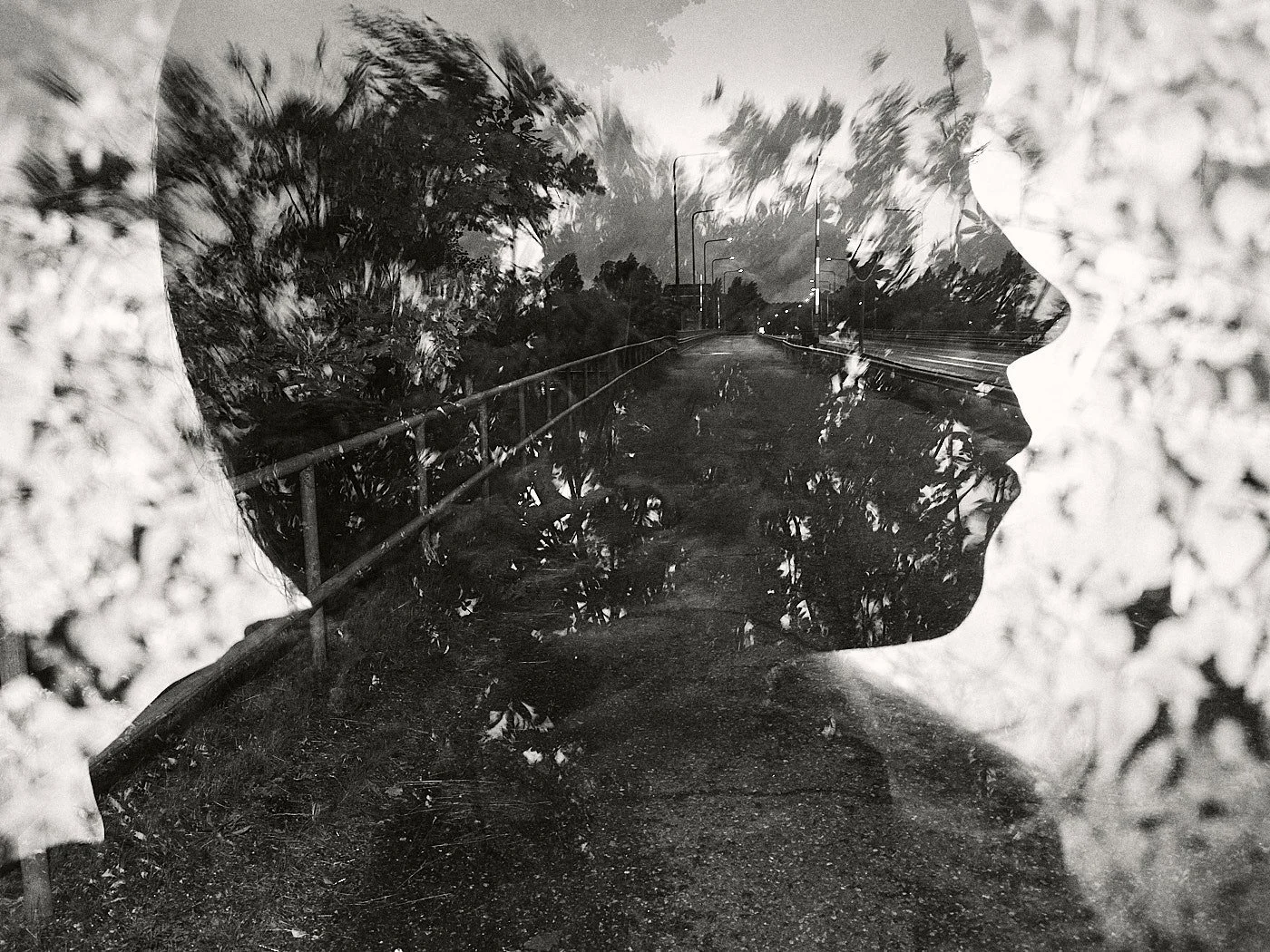
In-camera triple exposure from the ongoing “Doubled Days“ project.
The question comes up regularly: what exactly is a double exposure, and why keep working with a technique that's more than a century old?
Fair enough. Here's the short answer: double exposure means capturing two separate images on the same frame — either in-camera using film, or by layering exposures in digital post-processing. The result is a composite where one image bleeds into the other. Usually a portrait. Usually filled with something from the natural world.
The longer answer involves ghosts, surrealists, and the strange logic of how light behaves when it hits a surface twice.
A technique born from accident
Before digital photography, there was film. And film has a particular quality: expose it to light once, and it remembers. Expose it again, and it remembers that too. Every photon leaves a mark.
The earliest double exposures were mistakes. Someone forgot to advance the roll. Two unrelated moments ended up fused — a landscape bleeding into a portrait, a street scene haunting a window frame. But eventually, photographers started doing it deliberately.

William H. Mumler, Mary Todd Lincoln with the spirit of Abraham Lincoln, c. 1872. Public domain.
By the 1860s, an American named William H. Mumler was producing "spirit photographs" — portraits where ghostly figures appeared hovering behind the living subject. These were almost certainly staged using multiple exposures and careful darkroom work. Mary Todd Lincoln had herself photographed with the "ghost" of her assassinated husband standing behind her. The images were probably fraudulent, but they sold. People wanted to believe the camera could see more than the eye could.
The surrealists understood this differently. Not as proof of the supernatural, but as proof that photography could do more than document. Man Ray, László Moholy-Nagy, Harry Callahan — all of them treated the camera and the darkroom as tools for transformation rather than faithful reproduction. Callahan's double exposures of his wife Eleanor, layered against the streets and architecture of 1950s Chicago, remain some of the most quietly powerful photographs in the medium. Not tricks. Not gimmicks. Just two truths held in the same frame.
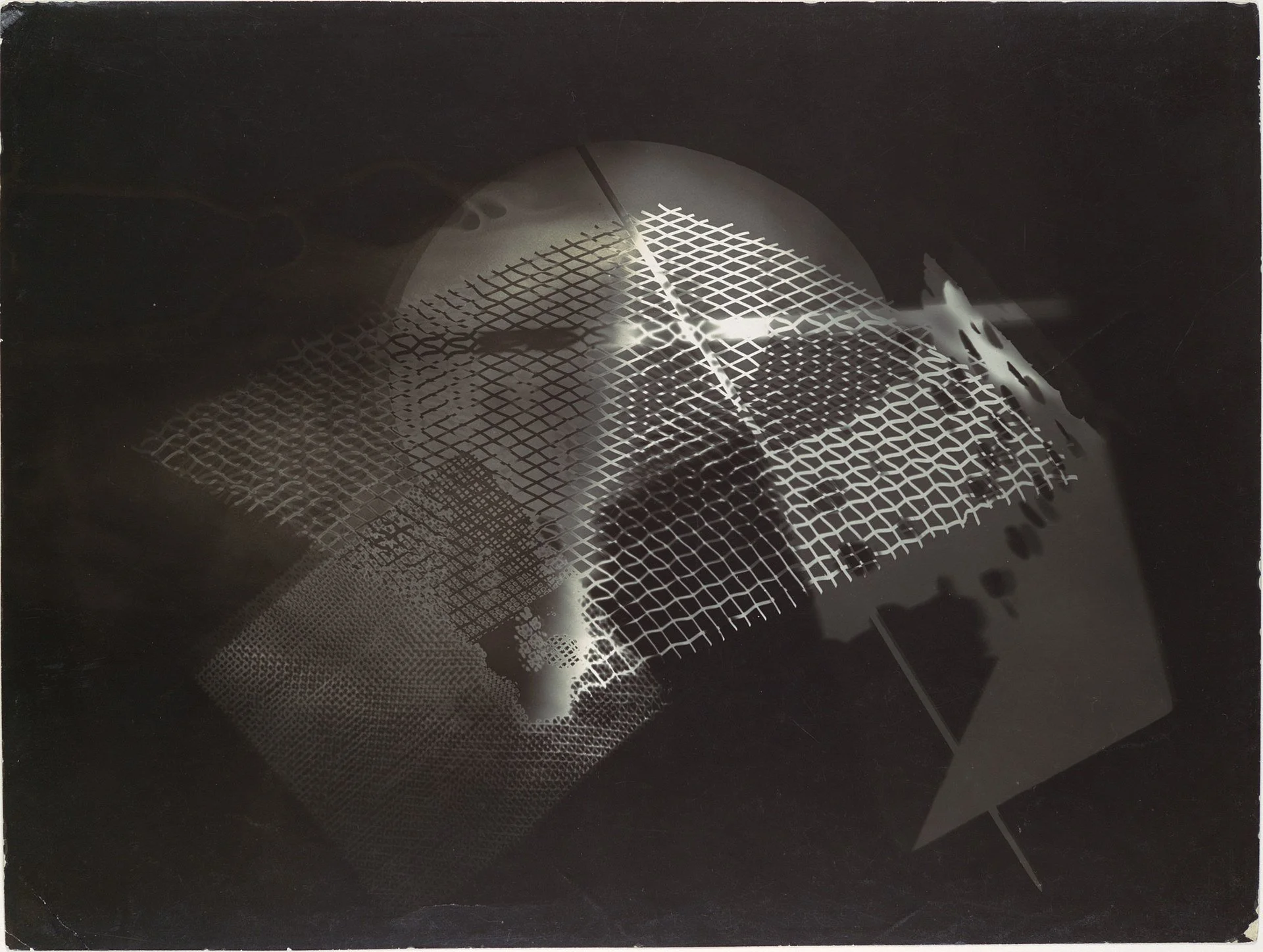
László Moholy-Nagy, Photogram, 1922. Light as raw material — the same logic that governs every double exposure.
The logic of light
Here's what happens when two images are layered on top of each other, whether on film or in digital post-processing:
Bright areas stay bright. Light adds to light. If the first exposure has a white sky, the second exposure won't show through. The brightest values dominate.
Dark areas absorb the second image. Shadows, blacks, underexposed regions — these are where the second photograph lives. This is why silhouettes work. A dark figure against a pale background becomes a window. Whatever fills that window depends entirely on what the camera is pointed at next.
This isn't manipulation in the Photoshop sense. It's closer to how transparent sheets of glass behave when stacked: where one is clear, the other shows through. Where one is opaque, nothing does.
Understanding this changes how double exposures are approached. The first shot isn't just a portrait — it's a shape. The second shot isn't decorative — it's structural. Both have to work together, or neither works at all.
Why it still matters
Filters exist. Generative AI exists. Software can composite images in seconds. So why bother with a technique that requires planning, precision, and often multiple failed attempts?
Because it requires exactly those things.
A double exposure demands intention at every stage. The quality of the light. The angle of the subject's head. The texture of the environment that will eventually fill the shadows — forest, water, clouds, bark. These decisions happen before the shutter is pressed, not after. The camera isn't documenting. It's constructing.
There's a discipline to this that feels increasingly uncommon. Also a slowness. Digital photography encourages speed — shoot hundreds of frames, sort later. Double exposure forces the opposite. Fewer frames. More attention. The result either works or it doesn't, and there's no amount of post-processing that will rescue a badly thought-through concept.
This might sound rigid. In practice, it's clarifying. The constraints are the point.
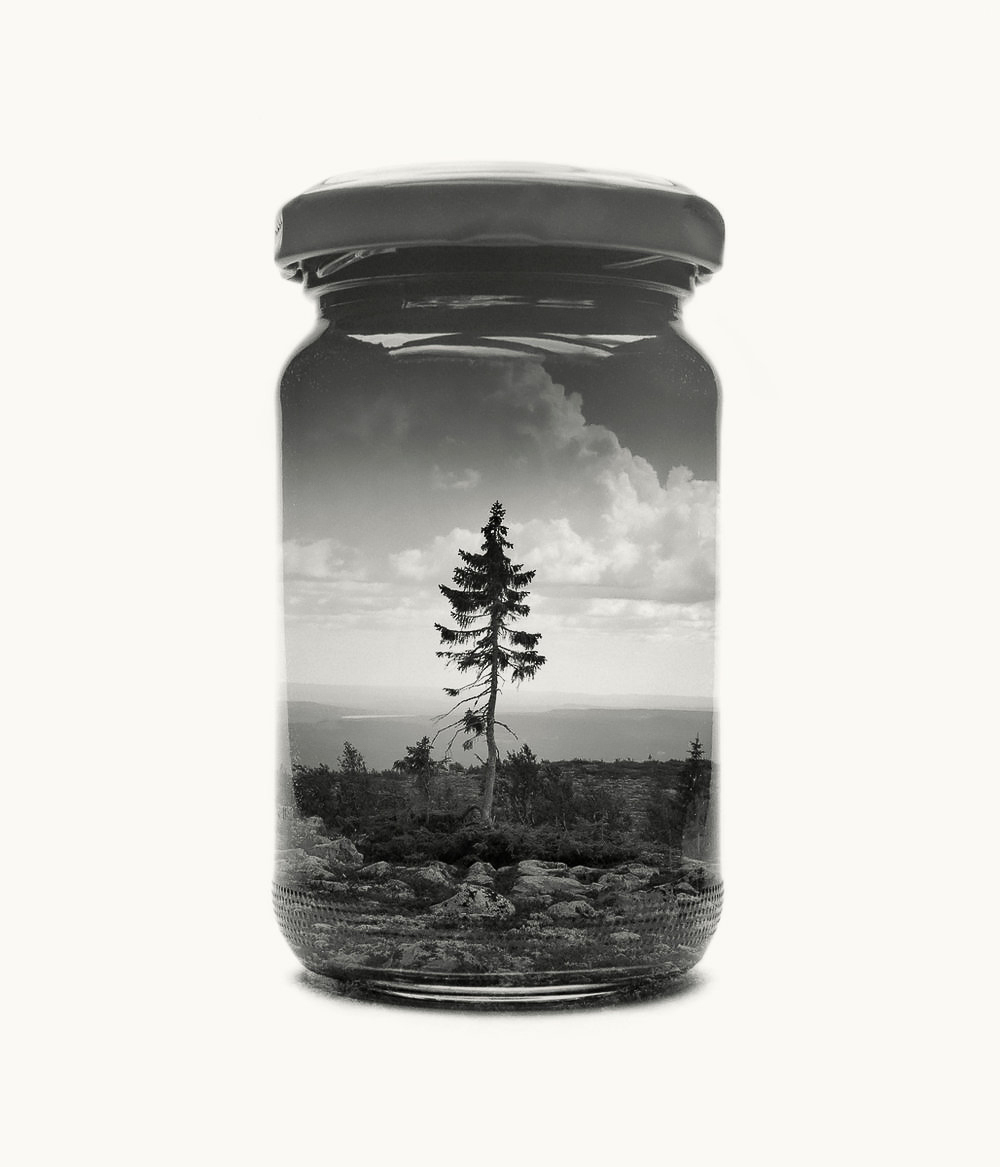
"Jarred Old Tjikko", Christoffer Relander, 2016. In-camera double exposure on medium format film.
Where this began
The forests and fields of rural Finland leave a mark. Long winters. Low light. Birch and pine. Lakes. Old growth so dense that the granite underneath disappears beneath moss. Growing up surrounded by that kind of landscape means never quite separating "self" from "environment" — the two always felt continuous.
When double exposure became a serious practice around 2010, it didn't feel like adopting a technique. It felt like finding a language that already made sense. A way of showing what had always been obvious: that people and places aren't separate subjects. The land shapes how we see. How we move. What we carry.
That became “We Are Nature”. Eventually, a book — “Dubbel Exponerat”, published in 2022 in Swedish. Since then, workshops and lectures with photographers who ask the same question in different ways: how do you make the invisible relationship between a person and their environment visible?
The technique is a starting point. The questions keep evolving.
Next: How double exposures are made — camera settings, light setups, and what happens in post-processing.
Christoffer Relander is a fine art photographer based on the Åland Islands. His book Dubbel Exponerat (2022) explores the double exposure technique through three series spanning over a decade of work.